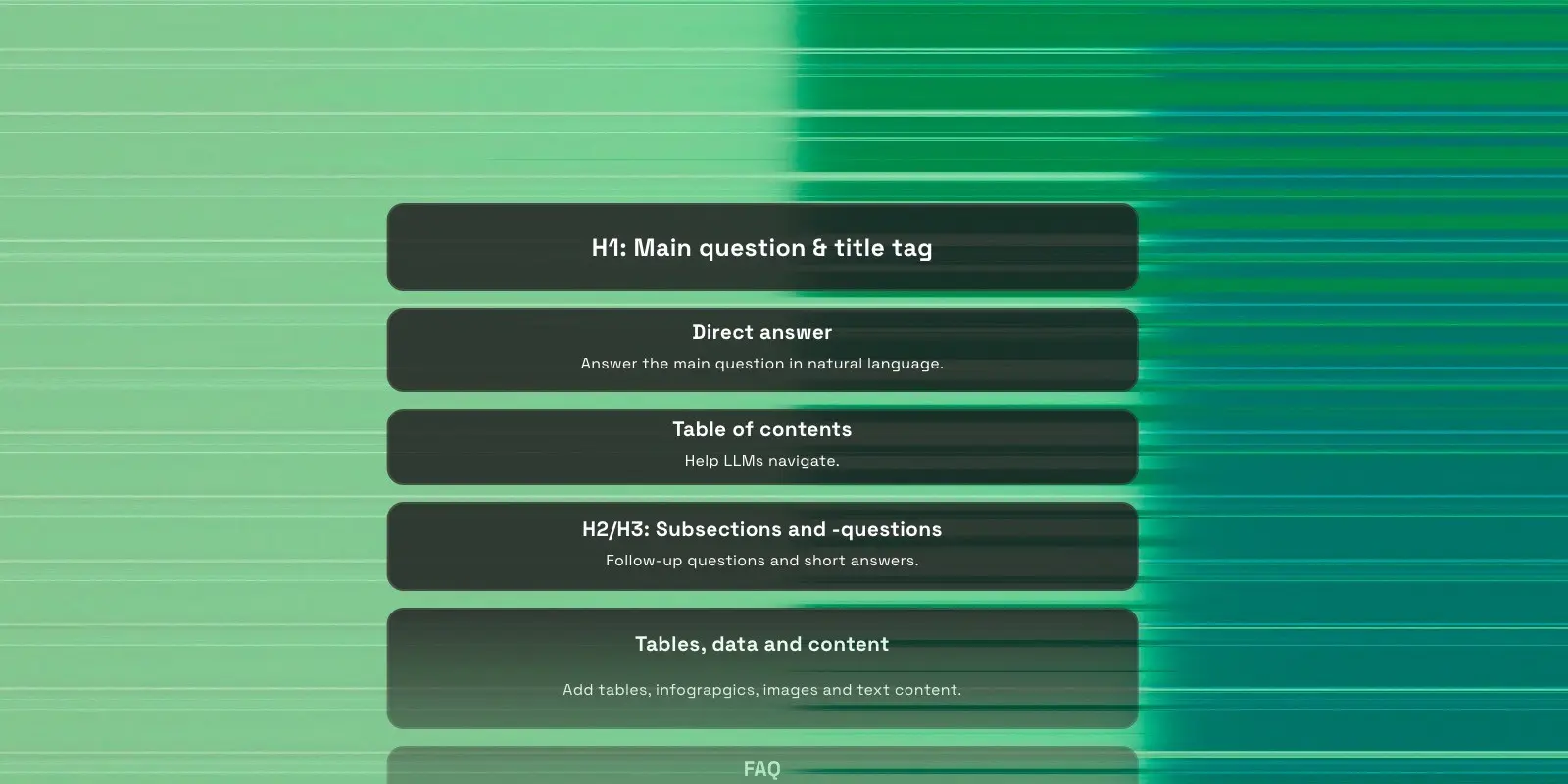
How to structure your content to rank in AI search
Key takeaways
- Code is King: AI models crave structure. Use proper HTML tags (H1, H2, H3) to create a logical hierarchy.
- The Direct Answer: Start your articles with a concise 2-3 sentence summary to capture the "Direct Answer" slot.
- Speak AI: Use Schema Markup (Review, Article, FAQ) to explicitly tell the AI what your content is.
- Match the Shape: Use Nimt.ai to see if the AI prefers Listicles or Guides for your keywords, and format your content to match.
You might have the best content in the world, but if an AI model can't parse it, you won't get cited. Unlike humans, who appreciate fancy layouts, LLMs (Large Language Models) crave structure, clarity, and code.
If you want ChatGPT and Gemini to use your content as the source of truth, you need to structure your webpages according to the AEO Blueprint. Here is the anatomy of a winner.
1. The "Direct Answer" Paragraph
AI models are often looking for a concise summary to serve the user.
-
The Tactic: Immediately after your H1 (Headline), include a 2-3 sentence summary that directly answers the core question of the page.
-
Why: This increases the chance of your content being picked up as the "Direct Answer" or snippet in an AI overview.
2. Use Clear Hierarchy (H2, H3, H4)
This sounds basic, but it is critical. AI uses heading tags to understand the context and relationship of information.
- The Tactic: Don't just bold text. Use actual HTML heading tags. Ensure that H2s are main topics and H3s are sub-points. A logical structure helps the AI "read" your article like a database.
3. Speak the AI's Language: Schema Markup
Schema Markup is code that helps search engines understand what your content is.
-
The Tactic: If you have a product review, use ReviewSchema. If it’s a generic guide, use ArticleSchema or FAQSchema.
-
The Nimt Insight: Our Boost Actions often recommend specific schema updates because we see a direct correlation between structured data and high citation rates.
4. Format for the "Shape" of the Answer (Content Types)
Does the AI want a list or a paragraph?
-
The Tactic: Check the Content Types report in Nimt.ai. If the winning answers for your keywords are Listicles, you must structure your content as a list (using
<li>tags). If they are Comparison Tables, build a table. -
Rule of thumb: Make data easy to extract. Use bullet points and tables generously.
5. Author Authority (E-E-A-T)
AI models are trained to prioritize safety and accuracy. They trust experts.
- The Tactic: Always include a clear Author Bio with links to LinkedIn or other credentials. Show the AI who wrote the content and why they are an expert.
Summary Writing for AI isn't about keyword stuffing. It's about Structuring for Retrieval. By organizing your high-quality content into a format that machines can easily understand, you drastically increase your chances of becoming the recommended source.
Related articles
View all
Martin Bergström
4 steps on how to win recommendations in the AI era
For 20 years, the goal of SEO was simple: Rank in the top 3 blue links. But the game has changed. Today, users aren't just searching; they are asking. And platforms like ChatGPT, Gemini, and Perplexity aren't just listing links; they are synthesizing answers.
Martin Bergström
3 AIO priorities for 2026: Your strategy to dominate AI-driven search
By 2026, AI-driven search results will no longer be news—they will be the standard. The traditional SEO strategy will lose ground. To secure your brand's visibility and impact, you must focus on three strategic priorities.
Martin Bergström
10 signs your SEO strategy is failing in the AI-driven search
The traditional SEO strategy no longer serves as a guarantee in a world dominated by LLMs. Looking only at organic traffic can hide the real crisis: that your brand is invisible in the new AI Search Funnel. Here are 10 clear signs that your current strategy is failing and how Nimt.ai's data can remedy the problem.